Stargazing tonight by city
Searching best stargazing locations near you? Open the pin-based Bortle map in Dark Sky Finder for ranked darker spots. This page is the city-hub directory: pick a tonight hub for score, cloud timing, and moon window. Guyana dark-sky towns and global peers are listed below by region. Every tool still works for any lat/lon on Earth.
Popular hubs: Quito · Nairobi · Tucson · Bortle map near you
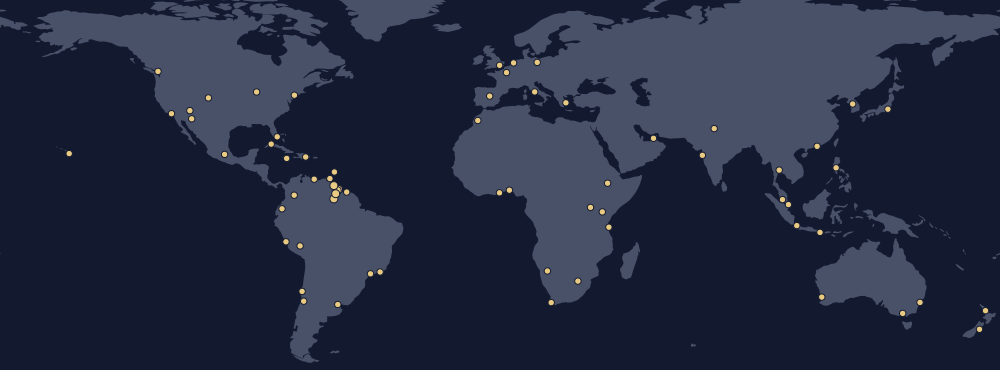
Jump to a region: Guyana · Caribbean · Latin America · Africa · North America · Europe · Asia · Oceania
Guyana
- Georgetown, Guyana: Demerara-Mahaica · ~6.8°N · city access hub. Coastal Georgetown sits under humid Atlantic trade winds, so transparency often improves after evening showers clear. Near-equatorial nights keep the Milky Way core high when the moon is down.
- Bartica, Guyana: Cuyuni-Mazaruni · dark-sky gateway · darker Bortle skies. Bartica is the classic jump-off toward darker Essequibo and interior skies once you leave coastal light domes. Check cloud decks and dew point before a night drive upriver.
- Lethem, Guyana: Rupununi · ~3.4°N · darker Bortle skies. Rupununi savannah around Lethem ranks among Guyana’s darkest accessible horizons. Dry-season nights reward wide-field Milky Way and satellite watching when dust settles.
- Mahdia, Guyana: Potaro-Siparuni · interior · darker Bortle skies. Interior Guyana near Mahdia stays far from coastal light pollution when weather cooperates. Confirm transparency and moon timing before committing to a forest-edge session.
- Mabaruma, Guyana: Barima-Waini · north-west · darker Bortle skies. North-west Guyana around Mabaruma is a dark-sky candidate with sparse settlement glow. Pair weather layers with a moonless dark-sky window for the best hours.
Caribbean
- Paramaribo, Suriname: Suriname coast · ~5.9°N · city access hub. Paramaribo shares Guyana’s near-equatorial sky clock but with a denser coastal light dome along the Suriname River. Inland clearings after tropical showers can open brief deep-sky windows.
- Port of Spain, Trinidad and Tobago: Trinidad · ~10.7°N · city access hub. Port of Spain’s urban glow pushes serious observing toward the Northern Range or Tobago’s quieter coasts. Dry-season nights still deliver bright ISS passes over the Gulf of Paria.
- Kingston, Jamaica: Jamaica · ~18.0°N · city access hub. Kingston’s basin traps city light, so Blue Mountains ridgelines are the usual escape for darker skies. Tropical convection means the clearest transparency often follows a late-day storm.
- Caracas, Venezuela: Capital District · ~10.5°N · city access hub. Caracas sits in a mountain valley where orographic cloud often hugs the hills while coastal Vargas stays clearer. Elevation helps transparency when trade-wind haze stays below the ridge.
- Havana, Cuba: La Habana · ~23.1°N · city access hub. Havana’s humid subtropical nights trade bright city glow for quick-clearing showers. Drive east toward darker Matanzas and Zapata shores when the forecast shows mid-level cloud dropping.
- Santo Domingo, Dominican Republic: Ozama · ~18.5°N · city access hub. Santo Domingo faces Atlantic moisture and afternoon thunderstorms that can leave crystal evenings. Interior Cordillera dark sites beat coastal light for deep-sky once humidity falls.
- Bridgetown, Barbados: St. Michael · ~13.1°N · city access hub. Barbados offers open Atlantic horizons with steady trade winds that keep dew moving. East-coast dark pockets away from Bridgetown glow reward short island drives on moonless nights.
Latin America
- Bogotá, Colombia: Andes · ~4.7°N · city access hub. High-altitude Bogotá nights cool quickly, but Andean cloud and humidity still decide transparency. Near-equatorial latitude keeps the galactic centre reachable for months when the altiplano clears.
- Quito, Ecuador: Andes · ~0.2°S · city access hub. Quito’s near-zero latitude puts both celestial poles low and the Milky Way nearly overhead in season. Thin Andean air helps when afternoon convection collapses after sunset.
- Lima, Peru: Pacific coast · ~12.0°S · city access hub. Lima’s coastal garúa cloud often blankets the city for weeks, so serious observers watch the Andean foothills inland. When the marine layer retreats, southern winter Milky Way nights open fast.
- Santiago, Chile: Central Chile · ~33.4°S · city access hub. Santiago sits under a bright valley light dome, yet nearby Andes foothills feed world-class Chilean dark-sky culture. Winter nights bring Magellanic Clouds and a towering southern Milky Way.
- La Serena, Chile: Coquimbo · astronomy coast · darker Bortle skies. La Serena anchors Chile’s Coquimbo astronomy corridor near Cerro Tololo and La Silla heritage skies. Coastal fog battles clear highland air — pick elevation carefully on any given night.
- Buenos Aires, Argentina: Río de la Plata · ~34.6°S · city access hub. Buenos Aires light pollution is intense, so dark-sky drives toward the pampas matter for deep-sky work. Southern winters still put the Magellanic Clouds and Scorpius high for coastal observers.
- São Paulo, Brazil: Southeast Brazil · ~23.6°S · city access hub. São Paulo’s megacity glow pushes astronomy toward Serra da Mantiqueira and coastal ranges. Humid subtropical nights reward patience — post-frontal dry air is when faint structure appears.
- Mexico City, Mexico: Valley of Mexico · ~19.4°N · city access hub. Mexico City’s altitude helps seeing, but valley smog and light drown faint targets from the centre. Clear winter nights over nearby volcanoes open rich tropical Milky Way views.
- Rio de Janeiro, Brazil: Guanabara · ~22.9°S · city access hub. Rio’s coastal mountains create microclimates — one bay cloudy while the other clears. Southern winter brings a bright galactic core over darker Serra sites west of the metro glow.
- Cusco, Peru: Andes · ~13.5°S · ~3400 m · darker Bortle skies. High Andean air above Cusco thins haze and sharpens southern deep-sky targets. Altitude cold and thin oxygen matter as much as cloud decks for long sessions near the Sacred Valley.
Africa
- Nairobi, Kenya: East Africa · ~1.3°S · city access hub. Near-equatorial Nairobi sits high enough that nights cool quickly after sunset, improving seeing when dust is low. City glow is strong, but highland escapes reveal both hemispheres’ summer Milky Way arcs.
- Lagos, Nigeria: Gulf of Guinea · ~6.5°N · city access hub. Lagos humidity and marine haze often mute faint detail even when the forecast says clear. Equatorial nights still reward bright planets and ISS passes over the lagoon when Harmattan dust is absent.
- Accra, Ghana: Gulf of Guinea · ~5.6°N · city access hub. Accra’s coastal light and sea mist favor bright-sky targets over faint nebulae from downtown. Dry-season Harmattan nights inland open longer dark windows for equatorial Milky Way photography.
- Addis Ababa, Ethiopia: Ethiopian Highlands · ~9.0°N · city access hub. Addis Ababa’s high elevation thins the air and can deliver sharp stellar images when the rainy season breaks. Urban glow is rising, so darker plateaus outside the capital unlock deeper southern sky views.
- Cape Town, South Africa: Western Cape · ~33.9°S · city access hub. Cape Town faces true southern skies: Magellanic Clouds, the Coal Sack, and a winter Milky Way that climbs high over Table Mountain. Atlantic fronts clear fast but return with equal speed.
- Windhoek, Namibia: Khomas · ~22.6°S · darker Bortle skies. Windhoek sits on the edge of Namibia’s legendary dark-sky highland and desert corridors. Dry air and sparse light pollution make it a southern-hemisphere deep-sky stronghold when dust storms stay away.
- Dar es Salaam, Tanzania: Indian Ocean coast · ~6.8°S · city access hub. Dar es Salaam’s coastal humidity fights inland Morogoro clarity, yet equatorial southern skies put Magellanic Clouds and the galactic core high when the monsoon lulls. Plan around Indian Ocean moisture surges.
- Kampala, Uganda: Lake Victoria · ~0.3°N · city access hub. Kampala sits almost on the equator beside Lake Victoria’s lake-effect cloud. Clear gaps open both celestial hemispheres at once — a rare planning advantage when mist lifts after midnight.
- Johannesburg, South Africa: Highveld · ~26.2°S · city access hub. Johannesburg’s Highveld altitude delivers thin air and crisp winter nights when dust settles. City light pushes serious imaging toward Magaliesberg and Karoo-direction escapes.
- Marrakesh, Morocco: Haouz · ~31.6°N · city access hub. Marrakesh sits under Sahara-edge skies where dust and heat haze compete with superb desert transparency. Atlas foothill sites often outclass the medina glow after a cool northerly.
North America
- Tucson, United States: Arizona · dark-sky city · darker Bortle skies. Tucson pioneered municipal dark-sky lighting and sits beside world-famous Sonoran observing sites. Dry desert air rewards summer monsoon gaps and long winter galaxy season nights.
- Flagstaff, United States: Arizona · first International Dark Sky City · darker Bortle skies. Flagstaff is the original International Dark Sky City, with high-elevation pine forests and Lowell Observatory heritage. Cold, dry winters deliver some of the Southwest’s steadiest transparency.
- Hilo, United States: Hawaiʻi Island · windward · darker Bortle skies. Hilo’s windward rain often yields to clearer Mauna Kea and saddle-road elevations just inland. Near-tropical latitude keeps both northern and southern deep-sky targets in play year-round.
- Los Angeles, United States: Southern California · ~34.1°N · city access hub. Los Angeles light pollution is extreme, so Mount Wilson, Angeles Crest, and desert escapes define real sessions. Santa Ana winds can produce rare crystal nights over the basin.
- New York, United States: Northeast · ~40.7°N · city access hub. New York’s skyglow limits most deep-sky work to bright satellites, planets, and lunar detail from the boroughs. Cold high-pressure winter nights are when upstate and Long Island dark sites shine.
- Denver, United States: Colorado Front Range · ~39.7°N · city access hub. Denver’s mile-high air thins turbulence, but Front Range light and upslope cloud still matter. A short drive into the Rockies unlocks darker summer Milky Way and winter galaxy fields.
- Vancouver, Canada: Pacific Northwest · ~49.3°N · city access hub. Vancouver’s marine layer and winter rain dominate, so clear arctic-outflow nights are gold. Summer twilight is long this far north — dark windows shrink around the solstice.
- Chicago, United States: Great Lakes · ~41.9°N · city access hub. Chicago winters can be brilliantly transparent after a dry cold front, while lake-effect cloud frustrates spring and fall. Light pollution pushes dark-sky trips toward rural Illinois and Wisconsin.
- Miami, United States: South Florida · ~25.8°N · city access hub. Miami’s subtropical moisture and city glow make Everglades and Keys horizons the real observing cards. Dry-season cold fronts briefly unlock sharp tropical nights over the Atlantic.
Europe
- London, United Kingdom: England · ~51.5°N · city access hub. London’s maritime climate means cloud is the main enemy more than dew alone. High northern latitude stretches summer twilight, so deep darkness is a winter and autumn prize.
- Paris, France: Île-de-France · ~48.9°N · city access hub. Paris light pollution is severe, pushing observers toward Île-de-France countryside and Champagne dark pockets. Anticyclonic winter nights bring the longest transparent windows of the year.
- Berlin, Germany: Brandenburg · ~52.5°N · city access hub. Berlin winters offer long nights and occasional crystal continental air after Siberian highs. City glow is strong, but Brandenburg lakes and forests remain popular dark-sky escapes.
- Madrid, Spain: Central Spain · ~40.4°N · city access hub. Madrid’s altitude and dry meseta climate favour sharp stellar images when pollution haze drops. Sierra de Guadarrama and darker Castilla sites open rich summer Milky Way sessions.
- Rome, Italy: Lazio · ~41.9°N · city access hub. Rome’s historic light dome limits faint targets inside the GRA ring, so Appennine foothills are the usual remedy. Mediterranean winters bring clearer transparency between Atlantic storm tracks.
- Amsterdam, Netherlands: North Holland · ~52.4°N · city access hub. Amsterdam’s maritime climate means frequent low cloud, yet North Sea clear-outs can be sudden. High-latitude summers barely get astronomical night — winter is the serious season.
- Athens, Greece: Attica · ~38.0°N · city access hub. Athens combines Mediterranean summer haze with superb autumn and spring transparency after meltemi winds. Island and mountain escapes outclass the Attica light bowl for deep-sky.
Asia
- Singapore, Singapore: Southeast Asia · ~1.4°N · city access hub. Urban Singapore needs careful transparency and light-pollution planning before chasing faint targets. Equatorial nights still deliver frequent ISS passes and bright planet alignments year-round.
- Jakarta, Indonesia: Java · ~6.2°S · city access hub. Tropical Jakarta nights fight dew, monsoon cloud, and dense urban glow along Java’s north coast. When the dry season settles, equatorial Milky Way hours return for highland escapes inland.
- Bangkok, Thailand: Central Thailand · ~13.8°N · city access hub. Bangkok’s heat island and haze favour bright objects unless you drive toward drier northeast or Gulf coasts. Cool-season nights (Nov–Feb) bring the year’s best transparency.
- Manila, Philippines: Luzon · ~14.6°N · city access hub. Manila Bay haze and metro light make Tagaytay and Cordillera escapes the practical dark-sky play. Typhoon-season breaks can leave superb transparency for a night or two.
- Kuala Lumpur, Malaysia: Peninsular Malaysia · ~3.1°N · city access hub. Kuala Lumpur’s equatorial convection builds towering afternoon storms that sometimes leave pristine late nights. Highlands toward Genting and Cameron open darker horizons than the Klang Valley floor.
- Tokyo, Japan: Kantō · ~35.7°N · city access hub. Tokyo’s skyglow is intense, so Okutama, Bōsō, and Izu dark sites define real deep-sky nights. Winter Siberian highs deliver the sharpest transparency of the year.
- Seoul, South Korea: Korean Peninsula · ~37.6°N · city access hub. Seoul’s dense light dome pushes observers toward Gangwon mountains and west-coast islands. Cold continental winters bring long nights and occasional crystal Siberian air masses.
- Mumbai, India: Konkan coast · ~19.1°N · city access hub. Mumbai’s monsoon and coastal haze dominate half the year, so post-monsoon winter nights are the serious season. City light pushes deep-sky work toward Western Ghats ridgelines.
- Delhi, India: Indo-Gangetic Plain · ~28.7°N · city access hub. Delhi winters can be cold and clear aloft yet smothered by fog and pollution near the ground. When air quality improves, northern winter constellations and bright planets put on a strong show.
- Dubai, United Arab Emirates: Persian Gulf · ~25.2°N · city access hub. Dubai’s desert air can be razor-sharp when dust settles, yet city megawatt glow and humidity spikes dominate. Inland desert reserves reward drives on moonless, post-shamál nights.
- Hong Kong, China: Pearl River Delta · ~22.3°N · city access hub. Hong Kong’s humid subtropical climate and dense urban light make Sai Kung and island ridges the practical dark options. Autumn high-pressure cells bring the year’s best transparency.
- Denpasar, Indonesia: Bali · ~8.7°S · city access hub. Bali’s wet-season cloud builds daily over the mountains while dry-season nights open rich southern skies. Darker east-coast and highland sites beat Denpasar’s coastal glow.
Oceania
- Sydney, Australia: New South Wales · ~33.9°S · city access hub. Sydney faces classic southern skies — Magellanic Clouds, Crux, and a winter Milky Way over the Tasman. Coastal humidity fights inland Blue Mountains clarity on many nights.
- Melbourne, Australia: Victoria · ~37.8°S · city access hub. Melbourne’s famous four-seasons-in-a-day weather means cloud forecasts matter more than light alone. Southern winters still deliver Magellanic Clouds and long galactic-centre nights inland.
- Auckland, New Zealand: North Island · ~36.9°S · city access hub. Auckland’s maritime climate brings frequent cloud, yet clear gaps open rich southern deep-sky vistas. Darker escapes toward Northland and Coromandel reward patience after a front passes.
- Perth, Australia: Western Australia · ~31.9°S · darker Bortle skies. Perth enjoys some of Australia’s driest, darkest accessible skies just east of the metro fringe. Southern winters put the galactic core and Magellanic Clouds in prime position over the Wheatbelt.
- Christchurch, New Zealand: South Island · ~43.5°S · city access hub. Christchurch sits under classic South Island southern skies with long winter nights and bright Magellanic Clouds. Alpine foehn clears can follow rain within hours — check the front timing.
Learn before you go
- Is tonight good for stargazing?
- Dark skies in Guyana
- Eclipses from Guyana, 2026-2045
- Milky Way season near the equator
- Dew and monsoon stargazing playbook
- How to see the Milky Way
- What is the Bortle scale?
Also explore what's in the sky tonight, the Moon tonight, planets visible tonight, zero-shadow days, and the interactive Solar System 3D explorer.